
Liberty County Court Records After a Jail Arrest
When someone is arrested and booked in Liberty County, the case does not stay with the sheriff. The State Attorney for the Second Judicial Circuit reviews the law-enforcement reports and decides what to file. That filing opens a court case, and the court record is where the formal charges, hearings, and disposition live. The arrest is the start of the story, but the court record after the arrest is the lasting account of what happened.
It helps to keep the two sides separate. The booking and custody side, including the roster and booking detail, is covered on the jail inmate records page, and booking photos are covered on the jail mugshots page. The court record is different. It reflects the charges the prosecutor actually filed and how the case moved, which is why a court records search after an arrest gives a fuller picture than the booking charge alone.
How to Find Liberty County Court Records After an Arrest
Liberty County court cases are searched through the Clerk of Court and the Civitek Florida online court records portal. The clerk homepage links a court-record search that opens the Civitek system, where the public can look up a case after it is filed. The arrest and booking detail stays on the jail side, so use the court portal for the charges and case events.
- Start at the Liberty County Clerk homepage and open the court-record search.
- Choose public access on the Liberty Civitek portal, then read and accept the disclaimer.
- Search by defendant name, or switch to case search where it is available.
- Open the case to read the charge list, then check each charge's code, level, and current status.
The clerk site is the front door for these records. A look at the homepage shows the court-record links and the clerk contact block.
The Liberty County Clerk of Court links the online court-record search.
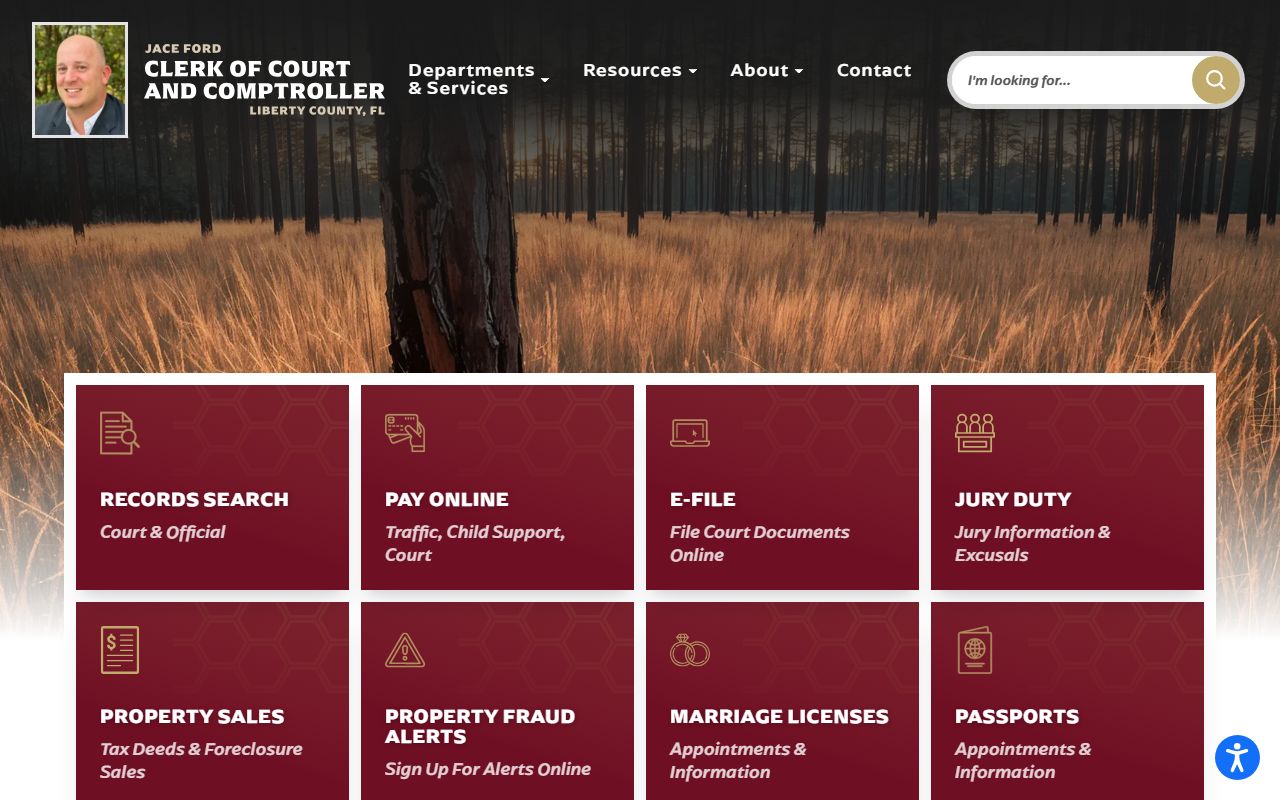
The public portal accepts a person search with the documented fields below, and it asks for a county choice and a disclaimer first.
| Field Label | Type | Required | Notes |
|---|---|---|---|
| Last Name | Text | Yes, unless using a business name | Maxlength 30 |
| First Name / MI | Text | No | Maxlength 40 |
| Date Filed (From / To) | Date | No | MM/DD/YYYY filter |
| Date of Birth | Date | No | MM/DD/YYYY |
| Court Type | Checkbox group | No | Felony (CF), Misdemeanor (MM), Criminal Traffic (CT), and more |
The Liberty access page lets the public, attorneys, registered users, and case parties in through different doors. A look at the access options and the search screen shows the public path.
The Liberty County Civitek access page sets out the public and credentialed options.
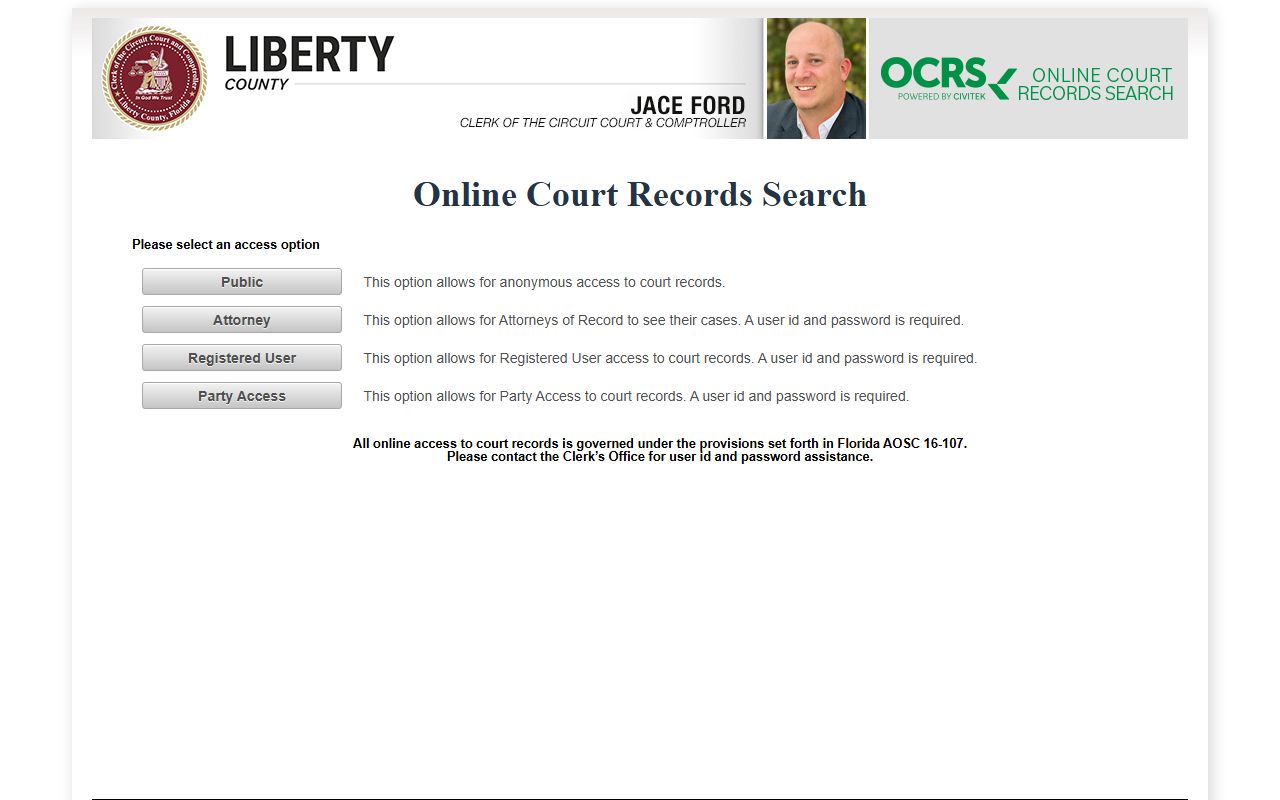
The public path is anonymous after the county choice and disclaimer, and a security check can interrupt automated access, so a person search by hand is the normal route. For records not visible online, contact the clerk directly.
How Charges Get Filed After an Arrest
The court record opens when a charging document is filed. After booking, the State Attorney decides whether to file, and the document type depends on the charge. In Florida, prosecutors commonly file an information for felonies and misdemeanors, while a grand jury returns an indictment for the most serious felonies. A complaint or sworn allegation can start some matters. Each one begins the case that becomes the court record.
| Complaint | Information | Indictment | |
|---|---|---|---|
| Filed By | Officer / Prosecutor | Prosecutor | Grand Jury |
| Common For | Some early or minor matters | Many felonies and misdemeanors | Serious felonies |
| Starts | The case | The case | The case |
Charge Status and What It Means
Charges change as a case moves. A prosecutor may amend, reduce, add, or drop charges, and a judge may dismiss them. The booking charge from the arrest can read differently from the charge the court finally lists, which is why the court record is the better source for the real status. The common status terms are below.
| Status | What It Means |
|---|---|
| Pending | The charge or case has not been resolved. |
| Amended / Reduced | The prosecutor or court changed the charge or lowered it. |
| Dismissed | The court did not proceed on the charge. |
| Nolle Prosequi | The prosecutor chose not to pursue the charge. |
Note: a disposition is the final status of a charge, such as a conviction, dismissal, acquittal, plea, or a withheld adjudication.
Bond and Release After an Arrest
Bond is the release condition set after an arrest. In Florida, a judge can set bond at first appearance, a warrant can carry a bond, or a later order can change it. Bond is not a finding of guilt or innocence. A person can stay in custody even after posting bond if another hold exists, such as a probation hold, another county's warrant, a federal hold, an ICE detainer, or a no-bond charge.
| Bond Type | How It Works |
|---|---|
| Cash Bond | The full amount is paid to the clerk, jail, or court as directed. |
| Surety Bond | A licensed bail agent posts the bond for a fee or collateral. |
| PR / Own Recognizance | The judge releases the person on a promise to appear, with conditions. |
| No-Bond Hold | Release is not available until the court changes the status. |
Confirm the exact bond amount, the bond type, and any holds with the jail at (850) 756-9749 before paying, and check the court docket for the first-appearance and bond entries.
Warrants That Lead to an Arrest
Many arrests start with a warrant. No public online warrant search was found for Liberty County, so the practical checks are by phone and through the court record. The Sheriff's Civil Process and Warrants function handles service questions at (850) 643-2235, and a bench warrant or capias tied to a case shows up in the court docket. For statewide entries, law enforcement uses the FCIC and NCIC systems, which are not public databases.
If a person may have an outstanding warrant, contacting the court or an attorney before appearing is wiser than relying on a web search that does not exist locally. Once a warrant arrest happens, the jail and the sheriff's records process confirm the booking, and the court docket carries the charge.
Charges vs. Convictions
Being arrested and charged is not the same as being convicted. A charge is an accusation that opens the court record, while a conviction is a verdict or plea at the end of the case. Both are public, but they mean very different things.
| Charge | Conviction | |
|---|---|---|
| Stage | Accusation | Verdict or plea |
| Burden of Proof | Probable cause | Beyond a reasonable doubt |
| Public Record | Yes | Yes |
Sealed vs. Expunged Arrest Records
Florida allows eligible records to be sealed or expunged after a dismissal or a qualifying outcome. The process generally requires a certificate of eligibility from the state law-enforcement department, a court petition, and court approval, and relief is usually limited to one arrest or incident. Sealing restricts public view, while expunction goes further and treats the record as removed.
| Sealed | Expunged | |
|---|---|---|
| Visibility | Hidden from public view | Destroyed or treated as never existed |
| Law Enforcement | Limited access | Very limited access |
| Eligibility | Certificate of eligibility and court order | Stricter, often after dismissal |
Background Check Considerations
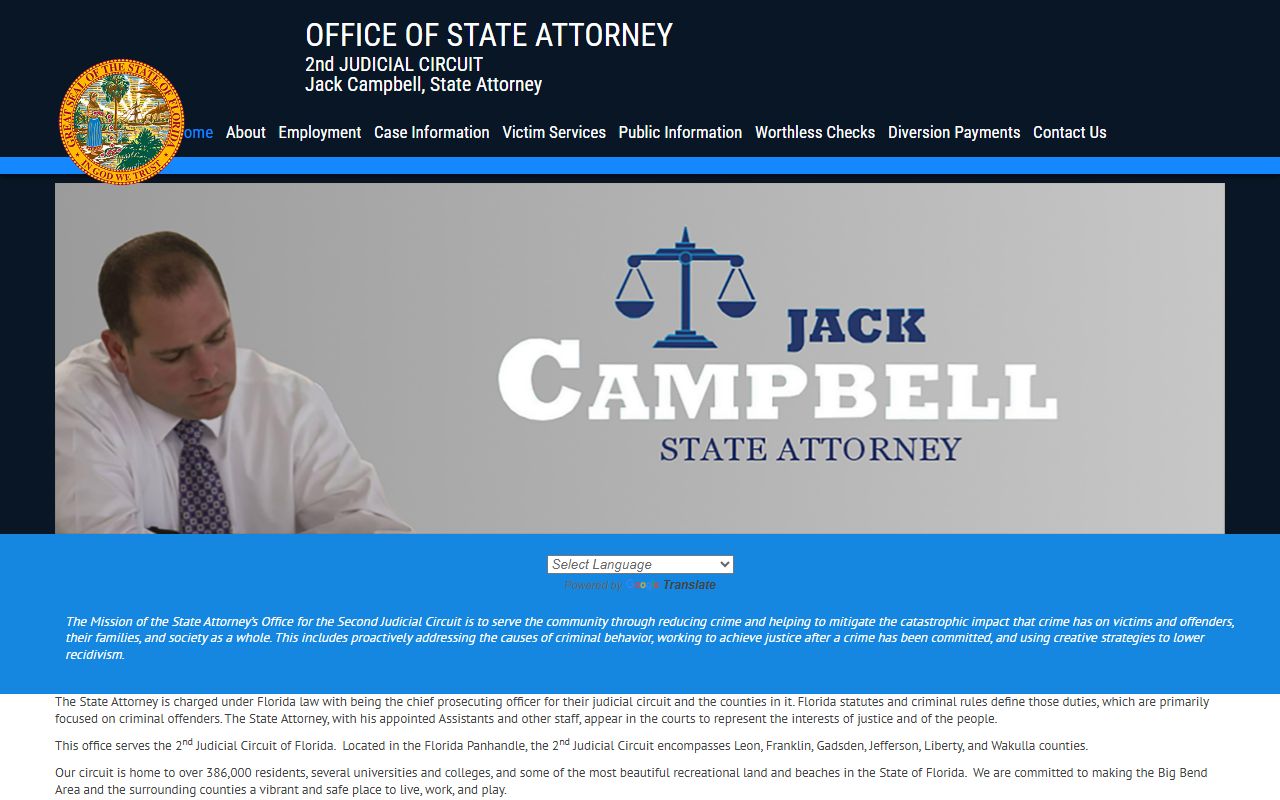
A casual court-record lookup is not the same as a regulated background check. Formal screening for jobs, housing, or credit must follow the federal Fair Credit Reporting Act and use a proper consumer reporting agency. The State Attorney for the Second Judicial Circuit, led by Jack Campbell, prosecutes Liberty County cases, and its homepage links Liberty cases to the Civitek court portal. A look at that office shows the case-information and victim-services links.
The State Attorney, Second Judicial Circuit serves Liberty and five neighboring counties.
Important: This is a private reference site and not a consumer reporting agency, so nothing here may be used for credit, employment, tenant, or insurance screening.
Court Record Terms After an Arrest
Court records after an arrest carry their own vocabulary, and a few terms shape how a case reads. These short definitions help when working through a docket.
- First appearance
- An early hearing where a judge reviews the arrest and considers release or bond.
- Arraignment
- The hearing where the formal charges are addressed and a plea or status is set.
- Capias
- A court-issued warrant, often for a failure to appear or a violation tied to a case.
- Disposition
- The final status of a charge, such as a conviction, dismissal, acquittal, or plea.
- Nolle prosequi
- A prosecutor's decision not to pursue a charge.
- Adjudication withheld
- A court outcome that avoids a formal conviction on an eligible charge.
Restricted Court Records After an Arrest in Liberty County
Not every court record after an arrest is open to the public. Juvenile cases, sealed or expunged charges, and records tied to an active investigation can be withheld or redacted under Florida law. Online court access is also narrower than the full courthouse file in some situations, and a public web user may see less than an attorney or a case party. When a record is not visible online, the clerk is the place to ask. A look at the public court search screen shows the Liberty access path.
The Civitek court-record search opens after the county choice and disclaimer.
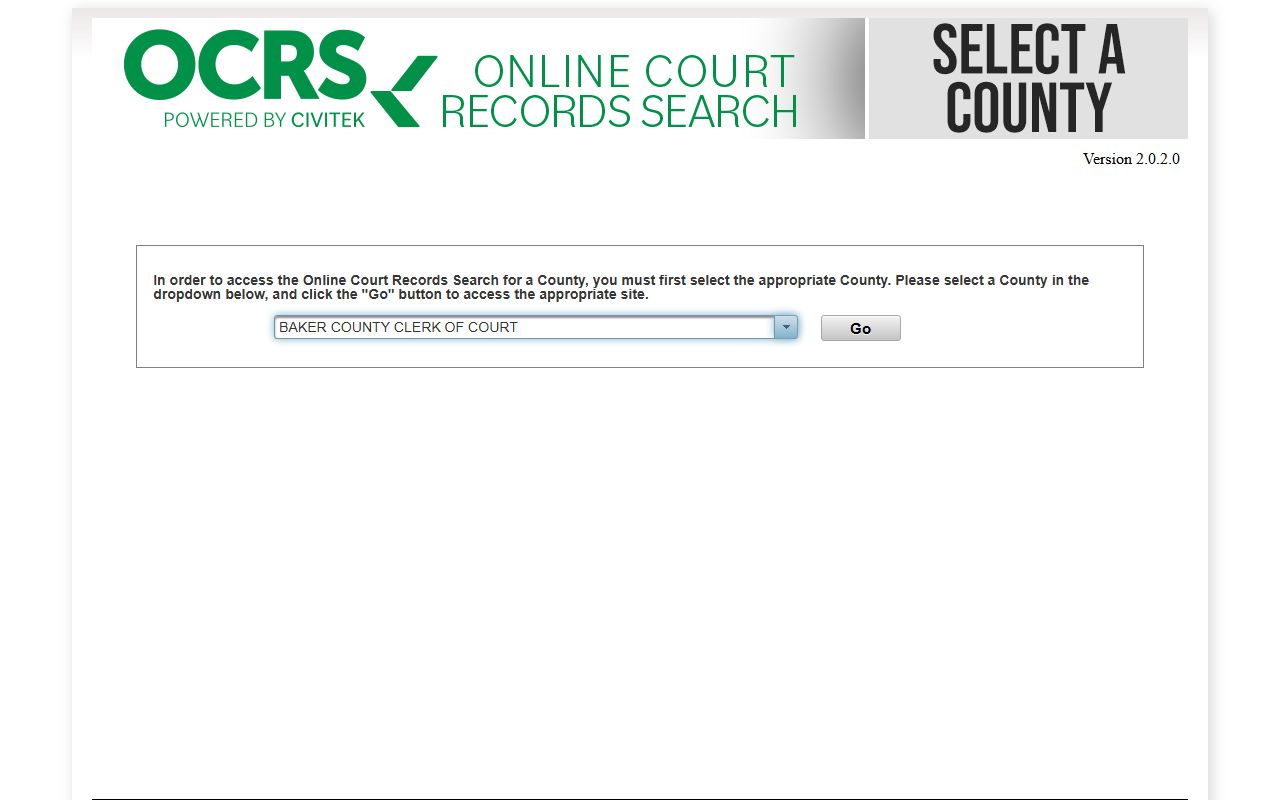
For confidential or restricted records, contact the Liberty County Clerk rather than assuming the case does not exist.